Procedures & Guidelines
The procedures and guidelines listed below apply to all organizations and/or individuals that provide food and/or beverages or any related services to Mason faculty, staff, students, or their guests at an event/activity on George Mason property.
Definitions
- Catering: Catering is the activity of providing food and/or drink for a group of people. Catering can be provided by either a caterer or a food provider. Catering can be paid with a Mason P-Card (F&B lift required prior to purchase) or billed directly to the university through a Purchase Order. Catering activities must not conflict with university contracts and will comply with all University policy, procedures, and all applicable federal, state, and local law.
- APPROVED CATERER: A caterer is an entity that provides catering. A caterer, by definition, must control the entire food and/or drink process from start to finish (storage, preparation, cooking, delivery, and distribution). If the process is not continuous (examples: grocery store purchases, pizza, and similar delivery services), they are considered a Food Provider. Only caterers that are on the Approved Caterer List at the time of the order or activity may provide catering for on campus activities.
- Catering Vendor: Catering Vendor is defined as a caterer participating in the act of vending sales. All events and activities with a Catering Vendor must follow University Policy 1110 (Vending Sales and Solicitation).
- AUTHORIZED FOOD PROVIDER: An Authorized Food Provider is a commercially licensed business where prepared food and/or beverage is packaged and available for take-away consumption including but not limited to: a grocery store, supermarket, restaurant, drive-thru, cafe, coffee shop, snack shop, convenience store, or similar fixed place. A food provider differs from a caterer in that the food provider does not distribute food to the customer for consumption. All food and/or drink must be provided in their final form from the food provider (raw materials cannot be combined, mixed, cooked to make different product) for distribution. The event/activity organizer is responsible to ensure all standard food handling safety protocols are followed.
Approved Caterers and Authorized Food Providers
- An Approved Caterer or an Authorized Food Provider must be used for all events and activities to ensure the health and safety of all event participants. The list of approved caterers is available online at Approved Caterers. If your preferred caterer is not an Approved Caterer, they must complete the Approved Caterer Process prior to any orders. This process can take up to two weeks. Note: Any grill or other cooking appliance that is not for personal use must be approved
by the Environmental, Health and Safety Office for the location being used. - If food is not fully prepared and served by the Approved Caterer from start to finish (storage, preparation, cooking, delivery, and distribution) then one must follow the procedures outlined in EVENTS AND ACTIVITIES NOT USING APPROVED CATERERS below.
Events and Activities Not Using Approved Caterers
1. Events
Events and activities with food that has NOT been prepared and distributed from start to finish (stored, prepped, cooked, delivered, and distributed) directly by an Approved Caterer must use an Authorized Food Provider and adhere to the following guidelines:
- All food and/or drink distributed must be commercially prepared (no "home-baked" goods) and should be individually sealed/pre-packaged by the Authorized Food Provider.
- Beverages provided in bulk serving containers are allowed only if they are procured from an Approved Caterer or Authorized Food Provider.
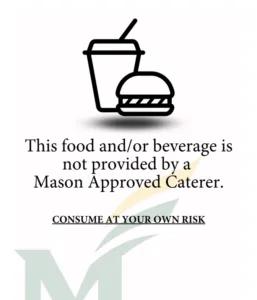
- An 8.5" x 11" (or larger) sign must be placed on all tables and areas where an event participant will receive food. The sign must be easily read and state "This food is not provided by a George Mason Approved Caterer. Consume at your own risk."
- If food is not individually sealed/pre-packaged by the Authorized Food Provider, then appropriate food handling standards must be followed. An example would be distributing individual donuts/pizza slices from a commercially packaged box.
- Any products and/or services sold or given away must not directly compete with the University’s current contracts which include, but not limited to: Sodexo Food Services, Coke Vending Company, Canteen Vending Company, Panda Express, Manhattan Pizza, Chipotle and Panera Bread.
2. Kiosks/Tabling and Fundraising Activities
For Kiosk and Tabling reservations that involve the distribution of food and/or drink an Authorized Food Provider(s) must be used and the organization must follow the following guidelines:
- All food and/or drink distributed must be commercially prepared (no "home-baked" goods) and should be individually sealed/pre-packaged by the Authorized Food Provider.
- Beverages provided in bulk serving containers are allowed only if they are procured from an Approved Caterer or Authorized Food Provider.
- An 8.5" x 11" (or larger) sign must be placed on all tables and areas where an event participant will receive food. The sign must be easily read and state "This food is not provided by a George Mason Approved Caterer. Consume at your own risk."
- If food is not individually sealed/pre-packaged by the Authorized Food Provider, then appropriate food handling standards must be followed. An example would be distributing individual donuts/pizza slices from a commercially packaged box.
- Any products and/or services sold or given away must not directly compete with the University’s current contracts which include, but not limited to: Sodexo Food Services, Coke Vending Company, Canteen Vending Company, Panda Express, Manhattan Pizza, Chipotle and Panera Bread.
3. Potlucks
"Potluck" style food provided by staff is allowed for meetings/lunches/birthdays, etc. when only departmental staff is attending in an enclosed space. Meetings that include staff from other departments must use the approved catering and authorized food provider procedures.
"Potluck" style food provided by Student Organization (RSO, DSO, …) members is allowed when a Student Organization has a finite list of members and only their members are attending. Meetings that include people not on the Student Organization membership list must use the approved catering procedures.
Potlucks are required to follow the following guidelines. Individuals of any Organization or Department providing food that are not authorized or approved as stated above may be held personally liable for the food provided and may be sued in the court of law.
- An 8.5" x 11" (or larger) sign must be placed on all tables and areas where an event participant will receive food. The sign must be easily read and state "This food is not provided by a George Mason Approved Caterer. Consume at your own risk."
- Organization is responsible for ensuring proper food handling standards are followed.
4. Grilling/Cooking on Campus
Organizations and/or Individuals that adhere to the procedures stated are allowed to conduct outdoor grilling only in approved locations. All grills installed on campus are for personal use only. Any grill or other cooking appliance that is not for personal use must be approved by the Environmental, Health and Safety Office.
- Charcoal is the only fuel source that is approved to be used in outdoor grills; compressed natural gas or propane grills are prohibited, except for commercial purposes as deemed necessary by EHS-Fire Safety.
- Grills must be at least twenty feet from any building, or structure (which includes tents, umbrellas, or amusement devices), and should not be near the air intake vents on a building.
- A minimum of one (1) five-pound ABC fire extinguisher must be within ten feet of each grill. EHS Fire Safety has extinguishers to lend for this purpose.
- Hot grills must never be left unattended.
- Grills must be maintained as per the manufacturer’s specifications.
- Ashes must be completely cool before disposal.
- Ashes must be disposed of in a metal trash can or container. Ashes may not be placed cool or hot in any plastic container or trash receptacle, including dumpsters.
- Any grill or other cooking appliance that is not for personal use must be approved by the Environmental, Health and Safety Office for the location being used.
Last Updated: February 17, 2023